The Future of 4Köppen: Towards Smarter Urban Infrastructure
Urban Design · July 2026 · 5 min read
Can public infrastructure do more than provide shelter?
4Köppen explores how climate-responsive architecture can improve everyday comfort by enabling tram stops to adapt to changing environmental conditions.
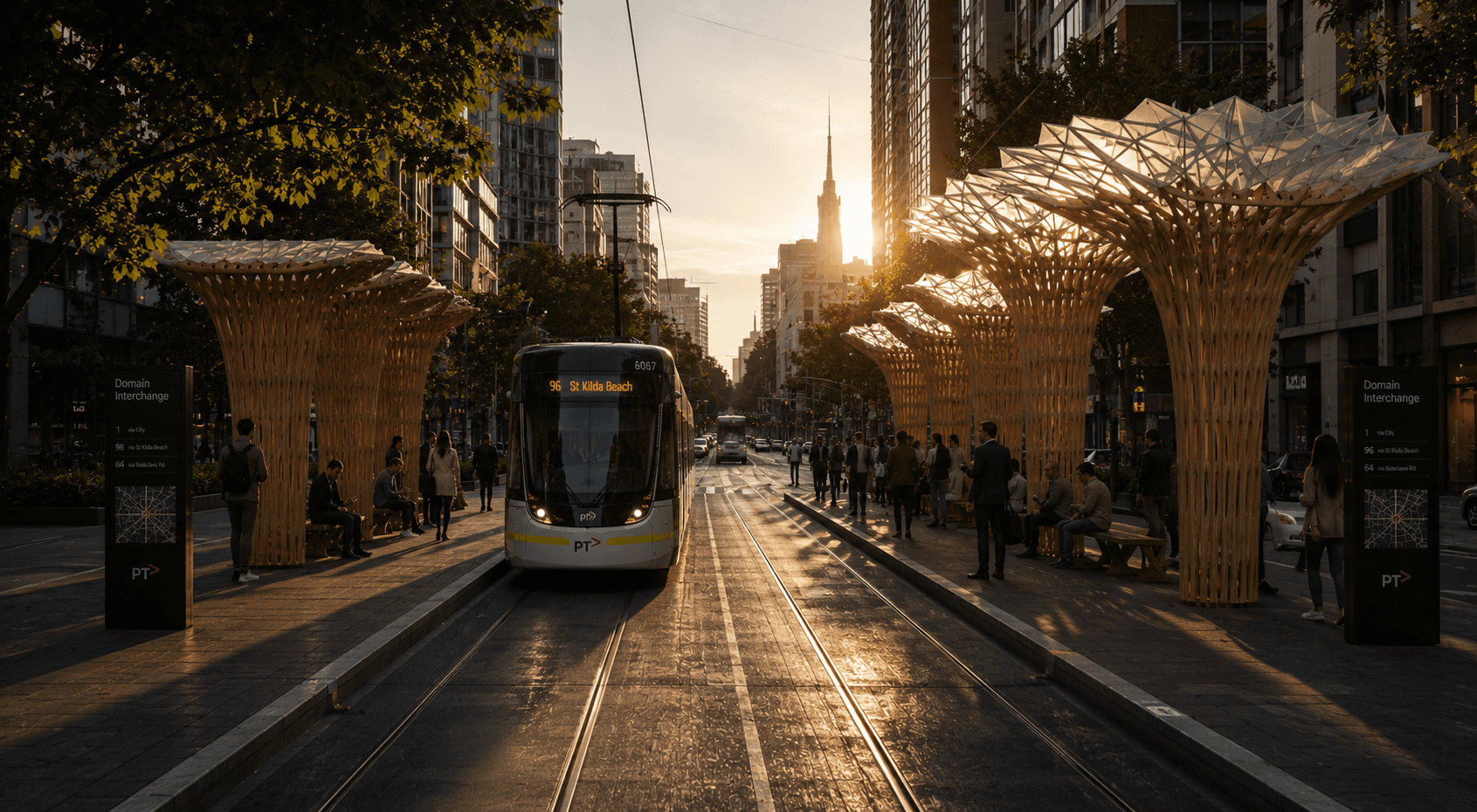

01 —
Designing with Climate
Climate became the project's primary design material.
Thai floor seating is more than a way of sitting—it reflects closeness, humility, and shared living. Kranok explores how these cultural values can evolve within contemporary spaces rather than simply preserving traditional forms.
From static shelter to adaptive public infrastructure.
02 —
Performing before form
Performance informed form—not the other way around.
Before defining the pavilion, the project focused on understanding how people, movement, and climate interact with the site.
Environmental research, site observations, and computational modelling informed every iteration, allowing environmental performance to shape the design from the beginning.
Environmental analysis informed every major design decision.
03 —
Designing the Experience
Environmental analysis informed every major design decision.
Instead of creating a static shelter, the project was designed as a responsive urban experience. Different environmental conditions trigger different behaviours, allowing the pavilion to balance sunlight, shade, ventilation, rain protection, and comfort throughout the day.
One adaptive system responding to four environmental conditions.
04 —
Behind the Design
Every design decision was tested before it was built.
While the final pavilion appears lightweight, every component was informed by computational workflows balancing environmental performance, structural logic, constructability, and material behaviour.
Performance became part of the design process—not something evaluated afterwards.
05 —
Looking Back
Responsive infrastructure should continue evolving.
Revisiting 4Köppen today, I would expand it beyond a responsive object into a connected urban system.
Real-time environmental sensing, modular construction, and AI-assisted control could enable each pavilion to respond not only to weather, but also to pedestrian activity and changing patterns of urban life.
More importantly, the project reinforced a simple belief: public infrastructure should do more than provide shelter—it should actively improve everyday urban experience.
Team: 4 members
Role
Urban Experience Designer · Architectural Designer
Focus
Climate-responsive Public Infrastructure
Methods
Environmental Research
Site Analysis
Computational Design
Parametric Modelling
Urban Design
Visualisation
01 —
Designing with Climate
Climate became the project's primary design material.
Thai floor seating is more than a way of sitting—it reflects closeness, humility, and shared living. Kranok explores how these cultural values can evolve within contemporary spaces rather than simply preserving traditional forms.
From static shelter to adaptive public infrastructure.
02 —
Performing before form
Performance informed form—not the other way around.
Before defining the pavilion, the project focused on understanding how people, movement, and climate interact with the site.
Environmental research, site observations, and computational modelling informed every iteration, allowing environmental performance to shape the design from the beginning.
Environmental analysis informed every major design decision.
03 —
Designing the Experience
Environmental analysis informed every major design decision.
Instead of creating a static shelter, the project was designed as a responsive urban experience. Different environmental conditions trigger different behaviours, allowing the pavilion to balance sunlight, shade, ventilation, rain protection, and comfort throughout the day.
One adaptive system responding to four environmental conditions.
04 —
Behind the Design
Every design decision was tested before it was built.
While the final pavilion appears lightweight, every component was informed by computational workflows balancing environmental performance, structural logic, constructability, and material behaviour.
Performance became part of the design process—not something evaluated afterwards.
05 —
Looking Back
Responsive infrastructure should continue evolving.
Revisiting 4Köppen today, I would expand it beyond a responsive object into a connected urban system.
Real-time environmental sensing, modular construction, and AI-assisted control could enable each pavilion to respond not only to weather, but also to pedestrian activity and changing patterns of urban life.
More importantly, the project reinforced a simple belief: public infrastructure should do more than provide shelter—it should actively improve everyday urban experience.
Team: 4 members
Role
Urban Experience Designer · Architectural Designer
Focus
Climate-responsive Public Infrastructure
Methods
Environmental Research
Site Analysis
Computational Design
Parametric Modelling
Urban Design
Visualisation


The Future of 4Köppen: Towards Smarter Urban Infrastructure
Urban Design · July 2026 · 5 min read
Can public infrastructure do more than provide shelter?
4Köppen explores how climate-responsive architecture can improve everyday comfort by enabling tram stops to adapt to changing environmental conditions.
01 —
Designing with Climate
Climate became the project's primary design material.
Thai floor seating is more than a way of sitting—it reflects closeness, humility, and shared living. Kranok explores how these cultural values can evolve within contemporary spaces rather than simply preserving traditional forms.
From static shelter to adaptive public infrastructure.
02 —
Performing before form
Performance informed form—not the other way around.
Before defining the pavilion, the project focused on understanding how people, movement, and climate interact with the site.
Environmental research, site observations, and computational modelling informed every iteration, allowing environmental performance to shape the design from the beginning.
Environmental analysis informed every major design decision.
03 —
Designing the Experience
Environmental analysis informed every major design decision.
Instead of creating a static shelter, the project was designed as a responsive urban experience. Different environmental conditions trigger different behaviours, allowing the pavilion to balance sunlight, shade, ventilation, rain protection, and comfort throughout the day.
One adaptive system responding to four environmental conditions.
04 —
Behind the Design
Every design decision was tested before it was built.
While the final pavilion appears lightweight, every component was informed by computational workflows balancing environmental performance, structural logic, constructability, and material behaviour.
Performance became part of the design process—not something evaluated afterwards.
05 —
Looking Back
Responsive infrastructure should continue evolving.
Revisiting 4Köppen today, I would expand it beyond a responsive object into a connected urban system.
Real-time environmental sensing, modular construction, and AI-assisted control could enable each pavilion to respond not only to weather, but also to pedestrian activity and changing patterns of urban life.
More importantly, the project reinforced a simple belief: public infrastructure should do more than provide shelter—it should actively improve everyday urban experience.
Team: 4 members
Role
Urban Experience Designer · Architectural Designer
Focus
Climate-responsive Public Infrastructure
Methods
Environmental Research
Site Analysis
Computational Design
Parametric Modelling
Urban Design
Visualisation